



Rainforest walk Teachers guide S
Secondary Teachers' Guide
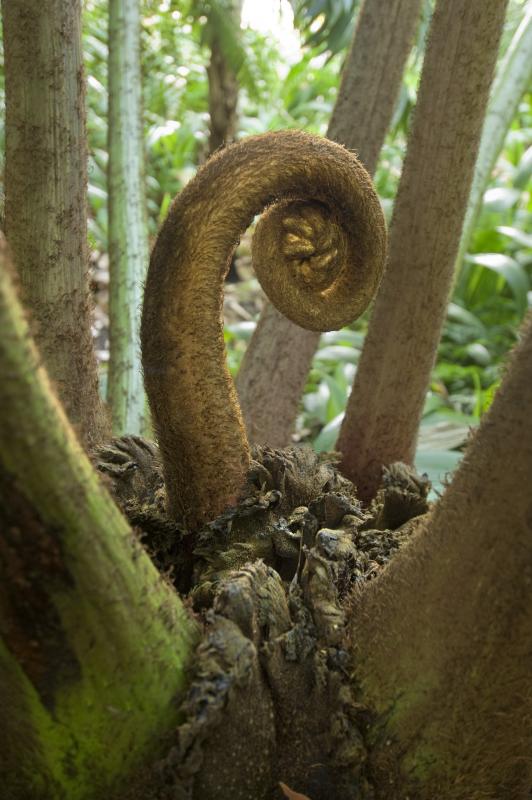
Education @ Adelaide Botanic Garden is made possible by a partnership between The Department for Education and Child Development and the Botanic Gardens of Adelaide.
Acknowlegements
Content: Steve Meredith and Michael Yeo
Illustrations: Gilbert Dashorst

Contents
- Bookings
- Subscribe
- Purpose and Australian Curriculum Connections
- How to use this guide
- Before and after the visit
- When in the garden (Guidelines for school groups)
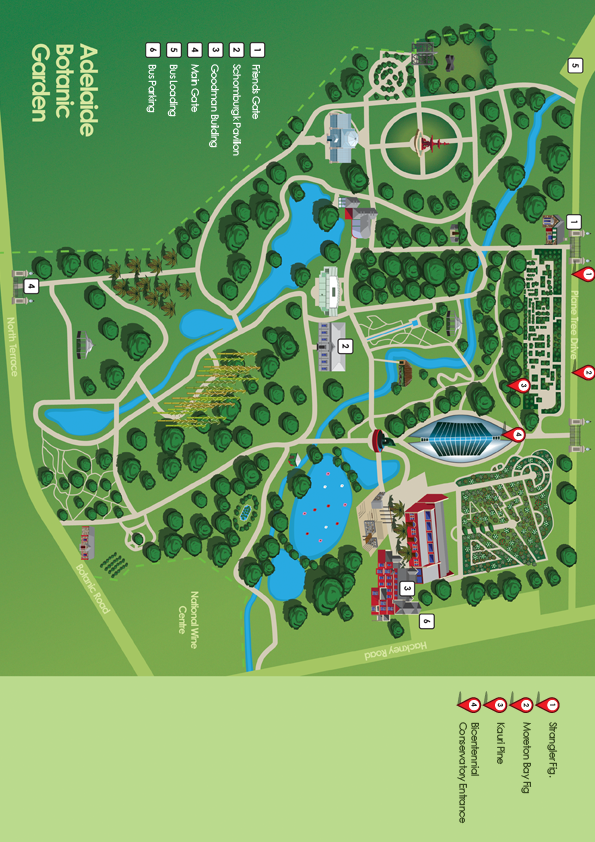
- Trail Map
- Plant information, key points and discussion ideas
Bookings
Bookings are essential
Whether teachers are planning a self managed visit or a session planned with the education manager, for reasons of risk management, emergency alert and OHS, bookings are essential for all school visits.
Phone: 82229311
Fax: 82229399
Online: www.botanic.sa.edu.au
Email: This email address is being protected from spambots. You need JavaScript enabled to view it.
To discuss possibilities or book the Education manager for a session
Phone: 82229344 or Email: This email address is being protected from spambots. You need JavaScript enabled to view it.
Subscribe
Stay up to date with what's happening by subscribing to our e-info newsletter.
© 2013 The State of South Australia, Department for Education and Child Development and the Botanic Gardens of Adelaide. This publication is protected by copyright. It may be reproduced by South Australian teachers for use with their students.
Purpose and Australian Curriculum Connections
Purpose: Rainforest Investigation Trail
Target year levels: 8 - 10
Key ideas:
- The ecosystem structure of a rainforest and the key adaptations of plants within it.
- The importance of rainforests and managing their sustainability.
Students will investigate a range of plants in
Students are encouraged to observe, analyse, inquire, record, hypothesize and connect knowledge they already have with new learnings.
TfEL: Provide an authentic context in which to engage learners and build their understanding whilst using a range of learning modes.
Australian Curriculum Connections
General capabilities
- Literacy
- Critical and creative thinking
- Ethical Behaviour
Cross-curriculum priorities
- Sustainability
Year 8
Geography: The interconnection of environments and people.
Visual Arts: Shape colour, patterns and design
Year 9
Geography: Cause and consequences of change on the unique environment of the Bicentennial Conservatory as a broader study.
Science: Ecosystems
Visual Arts: Shape colour, patterns and design
Year 10
Geography:
Science: Natural selection and diversity.
Visual Arts: Shape colour, patterns and design
Year 11
Visual Arts: Shape colour, patterns and design
Year 12
Visual Arts: Shape colour, patterns and design
How to use this guide
How to use this Guide:
This guide is designed to provide background information for teachers on each plant included in the walk. Some suggested student responses are included but they are by no means exhaustive. Many of the questions invite an open ended response and are of a sensory nature.
Finding the plants:
The plants on this trail may be found by referring to the appropriate map and by looking for the plant nameplate. The plants may be visited in any order. Allow about 1 hour to complete the trail.
Small GREEN tags on the nameplate will also assist in locating plants listed in the Bicentennial Conservatory. However, do not follow the large blue signs in the building.
Time:
Allow about 1 hour for this session.
Before and after the visit
The plants on the trail are numbered and may be found by referring to the map of the Adelaide Botanic Garden and by looking for plant name labels.
- The student guide should be photocopied so that each student has a copy of student activity materials and the map.
- Prior learning – it would be useful if students have a basic understanding of some of the terms used in the trail.
- This excursion is outdoors; students may require sun protection. In the colder weather raincoats or umbrellas are good. There are lots of protected spaces in the garden.
Before the visit:
Discussions:
The structure of a rainforest.
Vocab introduction:
|
JP |
Primary |
Secondary |
|
Emergents |
Emergents |
Emergents |
|
Canopy |
Canopy |
Canopy |
|
Understory |
Understory |
|
|
Parasite |
||
|
Epyphite |
||
|
Greenhouse effect |
||
|
Convergent evolution |
After the visit:
Encourage students to bring their family back again at a different time of the year.
When in the Garden
(Guidelines for school groups)In the garden students must be supervised at all times.
Before starting your walk please remind your group that:
- Gardens are peaceful places for people to relax and enjoy
- Walking slowly and talking quietly ensures everybody and everything will enjoy the gardens
- Plants are fragile, touch them gently
- Flowers, leaves, bark, seeds etc. growing on plants or lying on the ground are there for all to enjoy. When you have finished with plant material found on the ground always return it to the garden
- Keeping to paths and not walking on beds or borders avoids damage to plants.
The garden is a special place. Please leave it as you find it.
Map
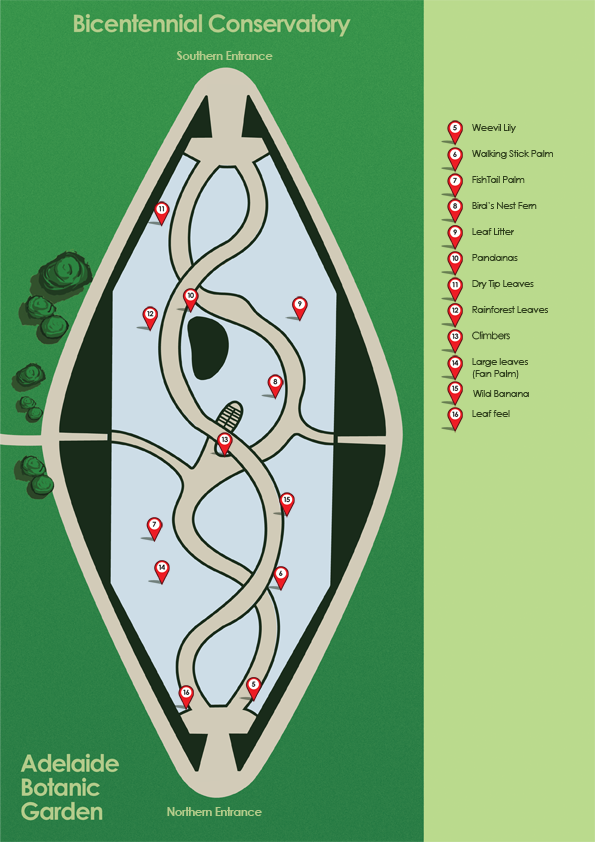
Plant information, key points and discussion ideas
The information below is background for teachers and does not appear on the Student Activity Guide.
1. Strangler Fig (Ficus thonningii)
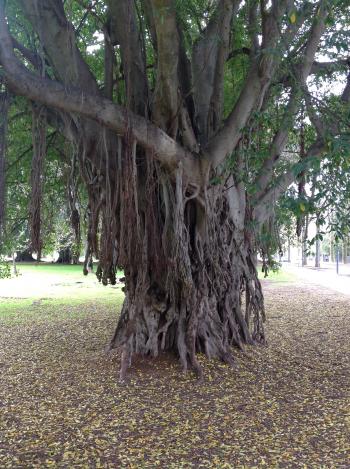
Although not growing as a strangler here this plant is capable of such growth in its natural habitat.
Stranglers often start from seed dropped by fruit eating birds, possums or bats high in the upper canopy where the young seedling is able to gain an early growth advantage due to the increase in available light.
The twisted pattern of the trunk and aerial roots gives an idea of its ability to encircle a host tree.
The strangler fig may weaken the host by shading it from sunlight and vigorously competing with it for nutrients from the soil. It can eventually kill older host trees that cannot cope with the rapid and aggressive growth of the strangler.
Aerial roots indicate the plant comes from a region of high humidity.
Key Ideas: There is great diversity of life in rainforests. Plants and animals are interdependent. Plants need sunlight to grow.
2. Mosses and Lichens - Epiphytes
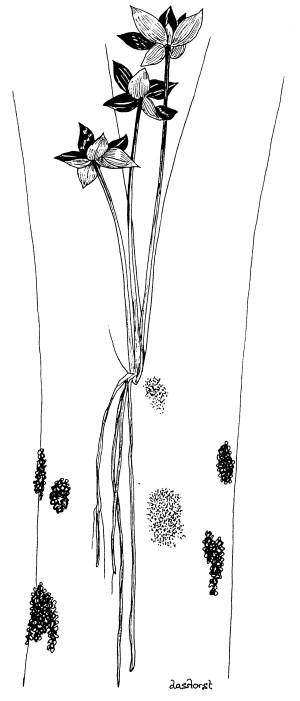
In a fork on the eastern side of this tree is a young fig that provides a good demonstration of how a strangler fig begins its life.
Also notice the mat-like covering of mosses and lichens growing on the tree trunk. Plants like these that grow on other plants without harming them are called epiphytes. They are very common in rainforests. Although they live away from the soil, and have the problem of less water and mineral nutrients, epiphytes have the advantage of more available light higher up in the canopy and less competition from the plants growing down below.
Further examples of epiphytes will be seen in the conservatory.
Key Ideas: Some rainforest plants live off the ground to get more sunlight.
3. Canopy Layer - Upper Canopy
Before moving into the circle of canopy trees near station 4, find a sunny open space and ask the students to note the factors of the climate such as temperature, sunlight, wind and humidity. Now move to the circle of trees and ask students to note the reduction in the temperature, light and wind. An increase in humidity would be harder to notice.
Looking up towards the tops of the trees students should note the canopy layer. The canopy layer reduces sunlight by up to 95%. The lack of light reaching the ground means many plants are epiphytes or climbers in the rainforest or they have adaptations to low light intensities. Note the lack of sun loving lawn growing under the canopy.
Key Ideas: The canopy layer changes the physical conditions for life in the understory.
4. Buttress Roots - Ficus macrophylla
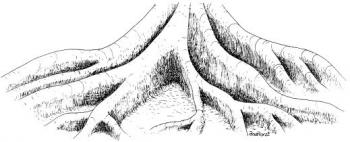
The large, shallow buttress roots help support the tree, absorb nutrients (generally found only near the surface of rainforest soils) and take in oxygen.
Broad scale, indiscriminate logging of large trees and the subsequent loss of soil binding roots and protective canopy leads to large scale erosion of rainforest soil.
Hundreds of epiphytic plants living on such trees may also be lost when just one large canopy tree is removed.
Key Ideas: Rainforest soils are generally shallow. Logging of rainforest can lead to long- term, irreparable damage.
5. Emergents
Stand near the Conservatory Gate and look to the right of the conservatory for these two large trees.
The Kauri Pine is in the foreground, the Bunya Pine is behind and to the right. As in a rainforest they appear to emerge from the canopy below. Now walk to the base of the Kauri.
The tall straight trunk of the Kauri Pine has branches and leaves only towards the top. This design is ideally suited to maximising light capture. The domed crown of the Bunya Pine in the background is also well designed for this purpose. Unfortunately, emergents make ideal logging specimens.
Key Ideas: Rainforest grows in layers. Plants have designs that help them grow in different layers.
6. Weevil Lily - (Molineria capitulata )
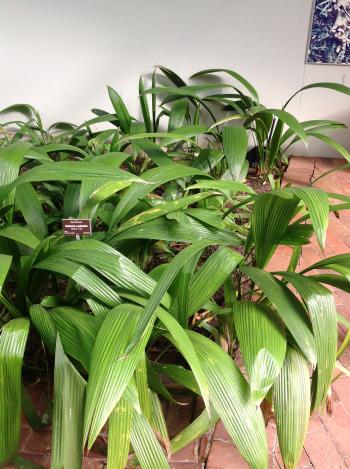
Molineria is unusual in that the flowers are not displayed above or within the leaves like most flowering plants. Its yellow flowers can be found attached to the main stem just above the ground. Ground dwelling ants, beetles or small marsupials may pollinate the flowers rather than birds or flying insects. A weevil is one particular known pollinator.
Key Ideas: There are many diverse plants in the rainforest with unusual features.
7. King Fern - Angiopteris evecta
Angiopteris is an ancient fern with ancestors going all the way back to when
It is reputed to have the largest frond of any fern on earth, growing up to 8 metres in length. They have no strengthening tissue and the frond relies upon internal water pressure to stay erect. Spores, held in cases called sori, line the edges of the undersides of the frond.
Angiopteris prefers to grow in streams and gullies. It is a spectacular plant that has great horticultural value as an indoor and outdoor plant.
Key Ideas:
8. Rose Apple - Syzygium moorei
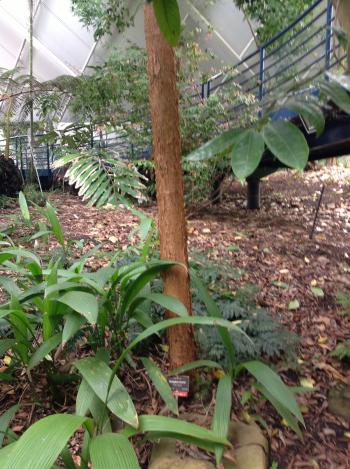
This plant has lost most of its original habitat due to clearing for growing sugar cane. Like many other rainforest plants cleared for agriculture, the continued survival of this species is under threat. Remnants of the original population of these trees are found only along the edges of
Stands left remaining on private property are threatened by future clearing.
Greater numbers need to be included in reserves before it can safely be preserved in the wild state. Acquisition of private land may assist the species preservation.
Botanic Gardens can help by:
- collecting seed to propagate wild plants
- education
- scientific research to ensure the species survival.
Key Ideas: Large areas of rainforest have been cleared for agriculture. Actions can be taken to conserve threatened rainforest habitat.
9. Walking Stick Palm - (Linospadix monostachya)
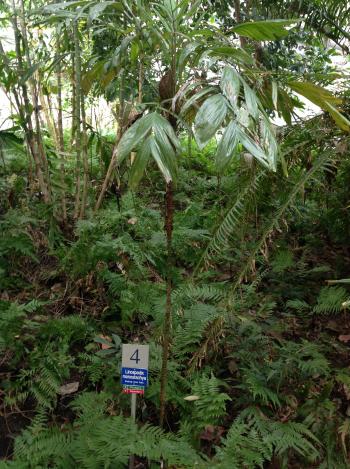
The strong narrow trunks of this palm were harvested in their thousands during World War 1 to make walking sticks for returned wounded soldiers. A comfortable handgrip was carved from the compact root ball found underground at the base of the stem. The small cabbage formed at the growing tip is edible, as are the ripe small red fruits.
Key Ideas: Rainforest plants have many different uses.
10. Powderpuff Lilly-pilly - Syzygium wilsonii
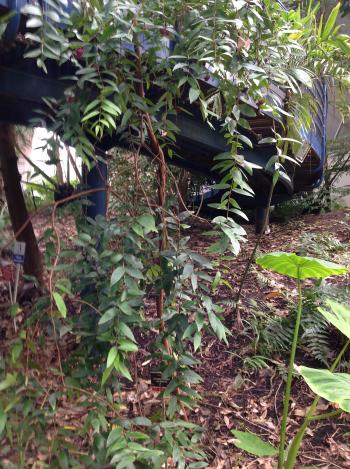
In season, the ends of branches have attractive crimson, gold-tipped flowers and rounded fleshy clusters of white fruit. This position on the end of branches enables birds and bats to more easily pollinate the flowers and eat the fruit to disperse the seed.
Key Ideas: Plants and animals in the rainforest are interdependent.
11. Wild Banana - (Musa banksii)
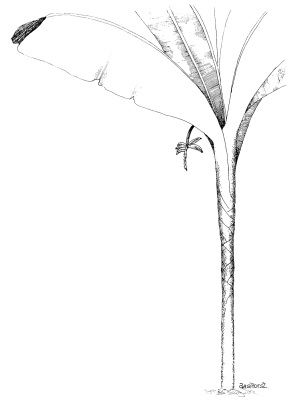
This is the commonest of native bananas with clumping stems to about 5 metres. The female part of the flower develops into finger-like bananas that turn yellow when ripe. Wild bananas are packed full of angular seeds. They are not fleshy and lack the flavour of cultivated bananas.
Wild plants that form the basis of farmed crops are important because they maintain a population of "wild" genes that may be called upon in the future to combat new pests and diseases that threaten our cultivated species.
Key Ideas: Wild gene populations, or biodiversity, is important ecologically and economically.
12. Climber (Epipremnum pinnatum)
Climbers are a common part of the rainforest, expending less energy to reach the light of the upper canopy than slower growing trunk building trees.
The Epipremnum is using its roots to climb the trunk of the palm tree. Other climbers nearby use spiraling stems. To the right, is a climbing palm that uses sharp, backward pointing spines along the leaf mid-rib to pull itself up into the canopy.
Climbers may eventually cover and compete with the trees that support them for light, water and mineral nutrients. Large woody climbers are called lianas and may run for over 300 metres in length through the rainforest.
Key Ideas: Some plants are climbers to increase their share of sunlight at the top of rainforest.
13. Leichhardt Tree - Nauclea orientalis
This tree has numerous traditional Aboriginal uses. Most tropical rainforests have been cleared for agriculture. Rainforest is being lost at over 1 hectare per minute. Over 100 million indigenous people still depend directly on rainforest, using it as their primary source of food, shelter, culture, medicine and religion. Without the rainforest these people suffer total loss. Many of these former forest dwellers find only poverty and a reduced quality of life when forced to move to nearby cities.
Key Ideas: Indigenous people can lose their whole way of life when rainforest is destroyed.
14. Tree Fern
This large tree fern is often planted in gardens. It is native to the cool mountainous areas of
Ferns do not produce seeds. If you look closely at the underside of the pinnules (small “leaves” which make up a frond) you may be able to see rows of tiny brown spots (sori). These brown spots house the spores which are the method of reproduction for the ferns.
15. Bird's Nest Fern - Asplenium nidus
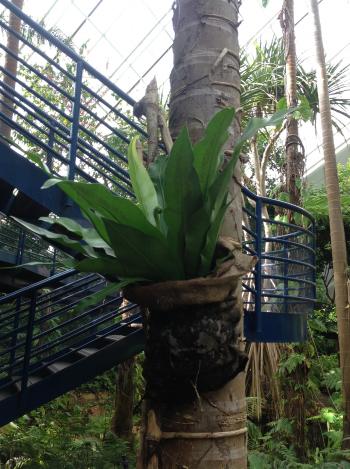
Epiphytes such as this are prolific in the rainforest. They grow on the trunks of larger trees without harming them. The spongy base has fibrous material capable of trapping and holding water. It resembles a bird's nest, hence the common name. The funnel like display of leaves channels water and debris falling from above to the centre of the plant. When decomposed the debris provides nutrients to the plant.
Ant debris or food leftovers brought into the centre of the plant can also be a source of mineral nutrition.
Key Ideas: Because epiphytes live off the ground, they have special designs to capture water and nutrients.
16. Leaf Litter
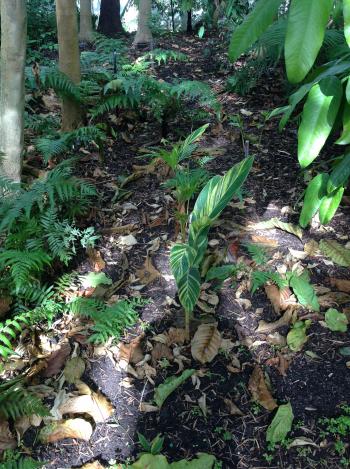
Many different stages of decaying leaves can be seen on the ground at this spot.
Large amounts of dead leaves, flowers, fruits and branches are shed from the rainforest canopy each year. This can be up to 8-10 tonnes/hectare annually. This litter is decomposed quickly by small insects and fungi that quickly return nutrients to the soil for the plants to re-use.
The process is rapid due to the warm, moist conditions on the forest floor. Insects and fungi can be seen amongst the litter at this stop.
This thin, recycled surface layer of nutrients is vital to the rapid growth of rainforest plants yet it is quickly leached away and lost when the forest is cleared.
Key Ideas: The litter layer is vital to the health of rainforest.
17. Pandanus oblatus
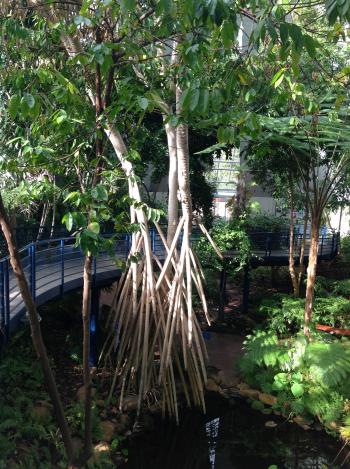
The upright, aerial roots hold up the central trunk and give the impression the plant is perched on stilts.
The stilt roots reduce the force of water during floods and raise the plant above advancing water levels. Organic material trapped between the roots decays over time and releases nutrients. The aerial roots also more easily obtain oxygen than roots in waterlogged soils.
Key Ideas: Some rainforest plants have adapted to very wet, flood prone soils.
18. Elephant Ears - Alocasia macrorrhiza
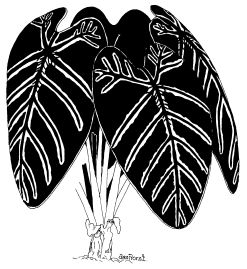
The smooth waxy coating, near vertical angle and sharply pointed drip tips all contribute to rapidly getting rid of water from the leaves.
These structures are best seen on new complete leaves.
A good example of a rainforest leaf covered by other plants can be seen in the photographs on the western wall at the city end of the conservatory.
Key Ideas: Constant moisture causes problems for plants. Plants have designs for dealing with this problem.
19. Native Ginger - Alpinia caerulea

Aboriginal people chewed the seeds inside the ripe, bright-blue, fleshy outer covering of the fruits of this plant. The ginger tasting tips that emerge from the roots are also edible.
The leaves were wrapped around food prior to cooking. When woven they made a covering for shelters.
Key Ideas: Aboriginal people have many different traditional uses of rainforest plants.
20. Fan Palm - Licuala speciosa

The native home of this commonly cultivated palm is in the New Hebrides. A discovery made only as late as 1970.
Due to low light intensities on the rainforest floor understorey plants often have large leaves to maximise the amount of sunlight they can absorb. Pleats in the leaves increase the surface area for light absorption. They also add strength to the leaf and prevent it from flopping down.
The stems are also green to increase the area for photosynthesis.
Key Ideas: Leaf design maximises sunlight capture under the canopy.